Headwaters
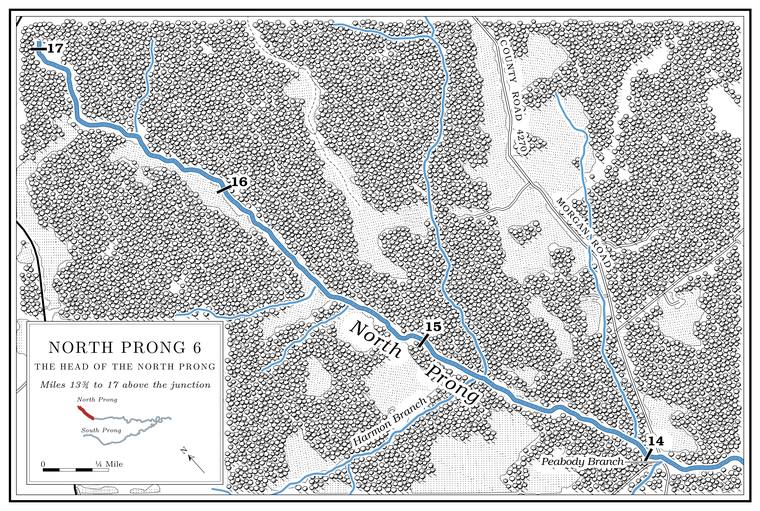
Source · about 9 miles south of Raymondville · North Prong mile 17.0 · Plate A14
The North Prong begins on the high, gentle ground of the plateau, where the heads of the Jacks Fork reach toward the main dividesee Chapter 2. of the Missouri Ozarks (Chapter 2). The nearest town is Raymondville, a village in Jackson Township named by Joseph W. Brackett for his old home in Raymond, Maine; its post office dates from the 1870sO’Brien 1939, 110 (post office from 1876).. No named spring is recorded at the head of the Prong. A branch or arm of a creek, set down in 1860 as Southern usage. The North and South Prongs join to form the Jacks Fork (Chapter 18). Glossary →.
Harmon Branch
Branch · right bank · about North Prong mile 14.8
Within its first two and a quarter miles the prong takes in two Branch. A small creek. The sense is American, on record from 1674 (Chapter 18). Glossary → of about the same size at nearly the same place: Harmon Branch from the west, draining a little over a square mile, and a branch with no recorded name from the northeast that drains slightly moreUSGS GNIS; Jacks Fork Creek Network 2026.. The Harmons were among the early settlers along the upper prong. John Harmon became postmaster of the Jack’s Fork office in 1869 and George E. Harmon in 1890Lewis 1980, PDF pp. 9, 11., and George E. Harmon was appointed at Grogan in 1900Lewis 1980, PDF p. 9; Rowe 2008 (Grogan: George E. Harmon, December 5, 1900). (see Route 137 below). No record ties the branch to any one of them. The name appears twice on the prong, here near its head and again at Harmon Hollow, eight and a half miles down.
Peabody Branch
Branch · right bank · about North Prong mile 14.0
Peabody Branch comes in from the southwest. It runs about a mile and three-quarters and drains about a square mile and a halfUSGS GNIS; Jacks Fork Creek Network 2026 (1.69 miles, straight line from source to mouth).. A little above its mouth a smaller branch with no recorded name enters from the northeast. Aaron T. Peabody was appointed postmaster at Grogan in 1900Lewis 1980, PDF p. 9; Rowe 2008 (Grogan: Aaron Peabody, March 28, 1900)., the same year as George E. Harmon, and the two branches at the head of the prong carry their surnames, though no record connects either branch to either man.